







When patients search for care, they rely on provider directories to guide them to the right clinician, without the risk of unexpected bills. Out-of-date directories can put patients at financial risk and create compliance challenges for health plans and providers.
The federal No Surprises Act, enacted in January 2022, addresses these risks by establishing nationwide protections against surprise medical billing and setting provider directory requirements. Under its provisions, both health plans and providers share responsibility for maintaining up-to-date, verified, and easily accessible directory information for patients.
What is the No Surprises Act?
The No Surprises Act is surprise billing legislation that protects patients from unexpected medical bills, commonly known as “surprise bills.” The law ensures patients aren’t caught in the middle of payment disputes between providers and health plans. It prohibits balance billing for:
- Most emergency services, including emergency medical billing related to mental health emergencies
- Non-emergency services from out-of-network providers at in-network facilities
- Out-of-network air ambulance providers
Provider Directory Accuracy Requirements
Accurate provider directories are also a central part of compliance with the No Surprises Act. The legislation requires health plans to verify provider directory information at least every 90 days, apply updates within two business days, and remove unverified providers until their information is confirmed. On the other side of this process, providers and facilities are obligated to submit timely updates and verify their data when requested.
Who is Responsible for Maintaining Accurate Provider Directories?
Responsibility for provider directory accuracy is shared between:
- Health Plans
- Providers
- Facilities
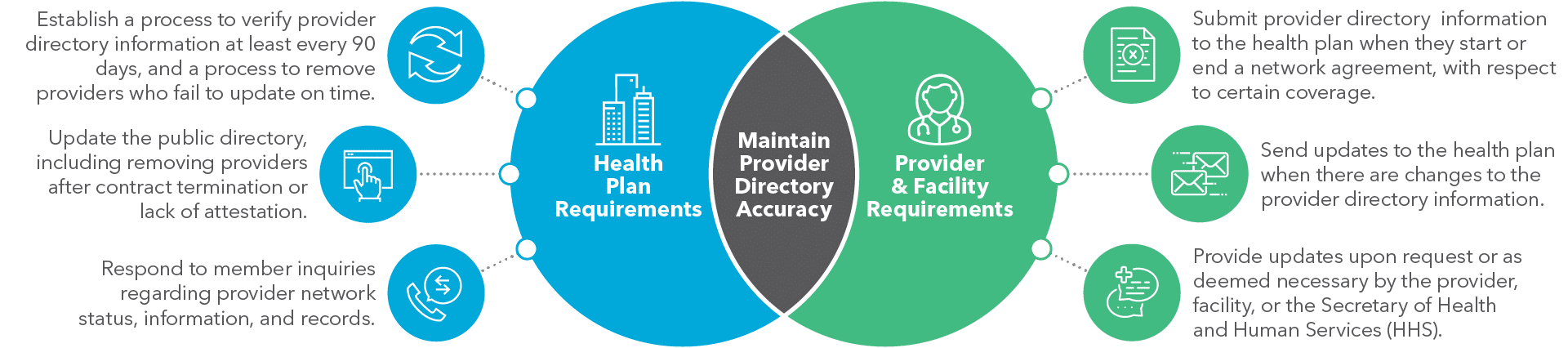

Health Plan Responsibilities Under the No Surprises Act
Health plans must maintain a publicly accessible and accurate provider directory of in-network providers and facilities. The No Surprises Act provider directory requirements include:
Provider Directory Verification Requirements
1. Directory Maintenance
- Online Directories: Maintain accurate directories on the website in a user-friendly format.
- Printed Directories: Include the last update date and direct consumers to the public website database for confirmation of provider participation.
2. Verification Protocols
- Verify and update provider directory information at least once every 90 days for each provider and facility with a direct or indirect contractual relationship. CMS requirements outline these verification and update obligations in detail.
- Providers or facilities that fail to respond must be removed from the directory until they verify their information.
3. Timely Updates
- Any updates submitted by providers or facilities must be reflected in the directories within two business days, including the removal of providers no longer in-network.
4. Member Communication
- When consumers inquire about a provider’s network status, health plans must respond within one business day.
How Health Plans Stay Compliant
Compliance with the provider directory accuracy laws requires repeatable, well-documented processes.
1. Develop a Provider Attestation Program Aligned with the Requirements
Develop a process to reach out to providers and facilities every 90 days for verification. Align the outreach cycle for each provider or group roster with their most recent attestation date. Additionally, implement a reliable method to easily integrate data updates.
Verify essential information, including, at a minimum: name, specialty, address, digital contact, patient availability, and network status.


2. Track Provider Outreach and Response Metrics
Compliance depends on the ability to demonstrate your ongoing efforts.
- Record all outreach attempts, including timing and outreach communication methods.
- Track provider responses, including the method of response, the last attested date, and the number of days they remained non-responsive.
💡 Tip: Discover the must-have provider outreach metrics to demonstrate compliance and ace your next directory audit. Read the article now.

3. Establish a Data Management Policy
Categorize providers based on their data verification status. These categories help determine the next steps for maintaining compliance while keeping the directory accurate:
- Validated Providers: Fully confirmed, no issues.
- Validated but Questionable Providers: Minor concerns; flagged for follow-up.
- Unverified Providers: Remove from the directory until verification occurs.
Providers and Facilities Responsibilities Under the No Surprises Act
Under the No Surprises Act, providers and facilities must also meet specific obligations:
What directory information must providers and facilities share and verify?
- Individual Providers: Name, address, specialty, telephone numbers, and digital contact information.
- Medical Groups, Clinics, or Facilities: Name, address, telephone number, and digital contact information for each entity contracted to participate in plan networks.
When must providers and facilities submit provider directory information to a health plan or issuer?
- When entering a network agreement with a health plan or issuer for certain coverage.
- When terminating a network agreement with a health plan or issuer for certain coverage.
- When there are material changes to the provider directory information.
- At any other time, including upon request from the health plan, issuer, or the Secretary of HHS.
Tips to Enhance the Provider & Health Plan Process
To streamline compliance and reduce administrative burdens, health plans and providers should:- Develop documented policies and procedures for provider data verification
- Use provider-plan contracts to define expectations regarding data verification, accountability measures, and timelines.
- Track outreach, responses, and verification status for audit readiness.
- Leverage technology solutions to automate data collection, attestation, and updates.
No Surprises Act FAQ
What is surprise billing?
Surprise billing occurs when patients receive care unknowingly or unavoidably from an out-of-network provider or facility, often in emergencies or at in-network facilities.
The No Surprises Act and related surprise billing legislation limit this practice in many situations, protecting patients from unexpected medical expenses.
What is balance billing?
Surprise billing can result in balance billing, which happens when a provider bills a patient for the difference between their charge and the amount the insurer pays. The balance billing law under the No Surprises Act limits this in specific situations.
Do providers and facilities have obligations under the No Surprises Act?
Yes, all providers and facilities must submit directory information at specified times to support health plans in maintaining accurate directories.
Who does the No Surprises Act apply to?
Group Health Plans
- Includes employer-sponsored plans, whether self-funded or fully insured.
- Third-party administrators managing self-funded plans must also comply.
Individual And Group Health Insurance Coverage
Includes plans sold both on and off the federal insurance marketplaces (exchanges) and state-based exchanges.
Federal Employee Health Benefit (FEHB) Plans
Non-federal governmental plans sponsored by state and local government employers (for example, a health plan through a school district).- Certain Church Plans within IRS jurisdiction
- Student Health Insurance Plans offered by colleges or universities.
Which health plans are exempt from the No Surprises Act?
- Medicare, TRICARE, Indian Health Services, and Veterans Affairs Health Care
- Certain other plans: Includes short-term, limited duration insurance, retiree-only plans, account-based group health plans, and excepted benefits plans (like standalone dental and vision coverage)
Are all states subject to the same directory requirements?
While the federal law applies nationwide, states may have additional requirements or parallel laws that plans must also comply with. State laws that impose stricter provider directory requirements remain in effect. The No Surprises Act sets a federal baseline, but states can go beyond these standards. We recommend deferring to existing state guidance for direction.
How Quest Analytics® Supports Health Plans and Providers
Provider data accuracy is a shared responsibility—and a common challenge—for both health plans and providers. Quest Analytics provides an integrated solution that automates key aspects of the data verification process, helping both parties reduce administrative burdens, improve data transparency, and comply with regulatory requirements.
For Practitioners and Large Groups
- Portal Attestation: Ideal for individuals and small groups.
- Roster Attestation: Designed for large groups and health systems.
For Health Plans
- Understand updates and track changes.
- Identify data gaps and prioritize next steps.

Stay Compliant with the No Surprises Act with Quest Analytics
The No Surprises Act represents a significant step forward in protecting patients from unexpected medical bills, but its success relies on accurate, up-to-date provider directories.
Partnering with trusted solutions, like Quest Analytics, can simplify compliance, ensure data accuracy, and keep health plans and providers prepared for audits. Staying proactive today helps avoid complications tomorrow and ensures patients always know where to turn for care.
Explore how automated solutions can reduce administrative work while keeping you aligned with regulations. Contact us today to learn how we can help.


Know Your Data, Grow Your Business
Get a complimentary strategy session with a Quest Analytics expert to learn how we can help you maintain network adequacy, improve data accuracy and achieve astonishing efficiencies.