Make an impact in healthcare while growing your skills and experience. Join a team that’s dedicated to improving the lives of healthcare consumers through innovation and collaboration.
Make an impact in healthcare while growing your skills and experience. Join a team that’s dedicated to improving the lives of healthcare consumers through innovation and collaboration.
The South Carolina Department of Health and
Human Services Puts Accurate, Timely Data at the Center of Medicaid Network Oversight
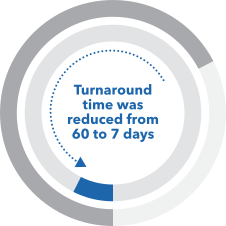
The new process using QES reduced the agency’s data turnaround time from approximately 60 days to about one week.
For the South Carolina Department of Health and Human Services (SC DHHS), their existing process for analyzing Medicaid Managed Care Organization (MCO) network data and conducting secret shopper programs was a source of growing frustration. It was slow, prone to stale data, and burdensome for both internal staff and providers.
With a small team and a mission to “boldly innovate in improving the health and quality of life for South Carolinians,” agency leadership knew they needed a better solution. The primary goal was to find a faster, more data-driven way to monitor network adequacy, identify gaps in provider availability, and build accurate and targeted secret shopper lists.
The Challenge
Slow, Burdensome Processes and Stale, Inaccurate Data
SC DHHS needed a more efficient, data-driven way to monitor network adequacy and appointment wait times required under new regulations from the Centers for Medicare & Medicaid Services (CMS).
“The first thing that we were facing was the inaccuracy of our internal data,” said the agency’s provider network analyst. “There are a few areas where we struggled just because of the nature of healthcare.”
Ghost providers— practitioners listed in plan directories who were no longer accepting Medicaid patients — were contaminating secret shopper call lists, wasting staff time, and placing unnecessary burden on providers’ front office staff.
And then there were the data bottlenecks — under the agency’s previous process, it took up to 60 days before network adequacy analyses of the health plans’ quarterly data submissions were ready for staff’s review.
“The problem we were running into was that by the time we were getting the data back, the data had already changed,” explained the agency’s provider network analyst. “Errors that had been flagged were often already corrected by the health plan, making the oversight effort duplicative and inefficient.”
The agency needed a solution that would allow them to:
Expedite network adequacy assessments.
Evaluate new network adequacy and appointment wait time requirements from CMS.
Streamline the use of secret shopper surveys to alleviate the burden on agency and provider staff.
Improve data accuracy and identify ghost providers.
Operate at scale with a small internal team of only two staff members.
The Decision
A Commitment to Smarter Oversight
In October 2024, SC DHHS decided to implement Quest Enterprise Services® (QES®) and Provider Claims Insights solutionsto address these challenges. The agency was quickly impressed by the platform’s speed, scalability, and the depth of expertise that the Quest Analytics team brought to the partnership.
Key capabilities that drove the decision included:
Automated Network Adequacy Workflows:
The software allowed the SC DHHS to quickly assess network compliance, identify provider gaps, and share results with MCOs.
Claims-Based Accuracy:
The proprietary claims-matching algorithms allowed the SC DHHS to identify providers who had submitted Medicaid claims within an 18-month window, to get a more accurate idea of providers actually seeing patients.
Targeted List Generation:
The platform enabled the agency to build secret shopper lists by specialty, making it easier to focus oversight where access gaps were most likely to affect beneficiaries.
Expert Support:
The Quest Analytics team provided hands-on guidance at every stage, from developing standards to data collection template creation and on-going support.
“You can’t ignore the experience and the expertise that the Quest Analytics team brings to the table. They look at things in a different way, which is very helpful, and they ask questions that make you think.”
— Provider Network Analyst, SC DHHS
The Results
Expedited Processes and More Accurate Data
With QES and Provider Claims Insights in place, SC DHHS revamped its approach to network monitoring and secret shopper compliance.
Automated workflows allowed the agency to quickly assess MCO compliance relative to the provider time and distance standards and provider count requirements. The new process using QES reduced the agency’s data turnaround time from approximately 60 days to about one week.
“The timeliness of the data was the big push for us to move to QES. Quest Analytics dropped our turnaround time to about one business week. That’s really what we needed for the network adequacy side.”
— Provider Network Analyst, SC DHHS
By leveraging claims data, the agency was able to remove ghost providers from secret shopper call lists, collaborate with MCOs to validate provider activity, and generate timely, targeted outreach lists. The agency also adopted a combined “revealed” and “secret” shopper call model that minimized disruption to practices by bundling multiple plan inquiries into single calls.
“We really don’t want to overwhelm practices, so we tried not to call during peak hours and considered ways to drop the call amount, yet gather that same amount of information,” explained the agency’s network provider analyst. “It’s important for agencies to remember that they’re dealing with real practices and real people on the other end.”
The impact extended beyond operational efficiency. The claims data has also enhanced the agency’s strategic planning, helping the SC DHHS team make the case for possibly including autism services, pediatric specialties, and pharmacy access into South Carolina’s time and distance standards in the future.
“We were able to prove that we have the capacity to bring it into a time and distance requirement, and now we’re trying to go to the next step and leverage that for leadership to justify expanding our network in the state,” the provider network analyst explained.
The Future
A Closed-Loop Compliance Framework
Looking ahead, SC DHHS is working to create a closedloop monitoring cycle among agency staff, Quest Analytics, MCOs, and the agency’s secret shopper vendor. By linking claims-informed directories, appointment access calls, and real-time feedback, the agency aims to build a sustainable compliance framework that can adapt as federal rules evolve.
“The goal is for each part of the process to inform the next,” said the director of targeted oversight for the agency’s Bureau of Managed Care. “We use QES to identify potential ghost network providers, which then directs our secret shopping efforts. Based on how plans respond to those secret shoppers, we determine whether a provider should be considered active and eligible within a Medicare managed care organization’s enrollment.”
Near-term plans include differentiating primary versus secondary practice locations for more precise call targeting and leveraging QES to meet the Managed Care Final Rule’s more intensive appointment access exception reporting requirements.
“Looking down the road, the ability to easily and visually track the exception process for states is going to be huge,” said the director of targeted oversight. “I think that’s really going to be important to leverage, especially when it comes to picking our own internal state focus, documenting it, holding plans accountable, and making sure that we can actually meet the compliance requirements.”
The agency’s advice to other state Medicaid programs is straightforward: think beyond your immediate needs. “We fixed our immediate needs, but now we’re really looking into how to make this tool continue to work for us in the future,” said the agency’s provider network analyst. “We’re excited about the possibilities.”
Modernize Your Network Adequacy Process
Quest Analytics® offers software and services to efficiently and cost-effectively analyze health plan provider data to determine compliance with agency-specified network adequacy requirements. Contact our regulatory team at regulatory@questanalytics.com to learn more.